
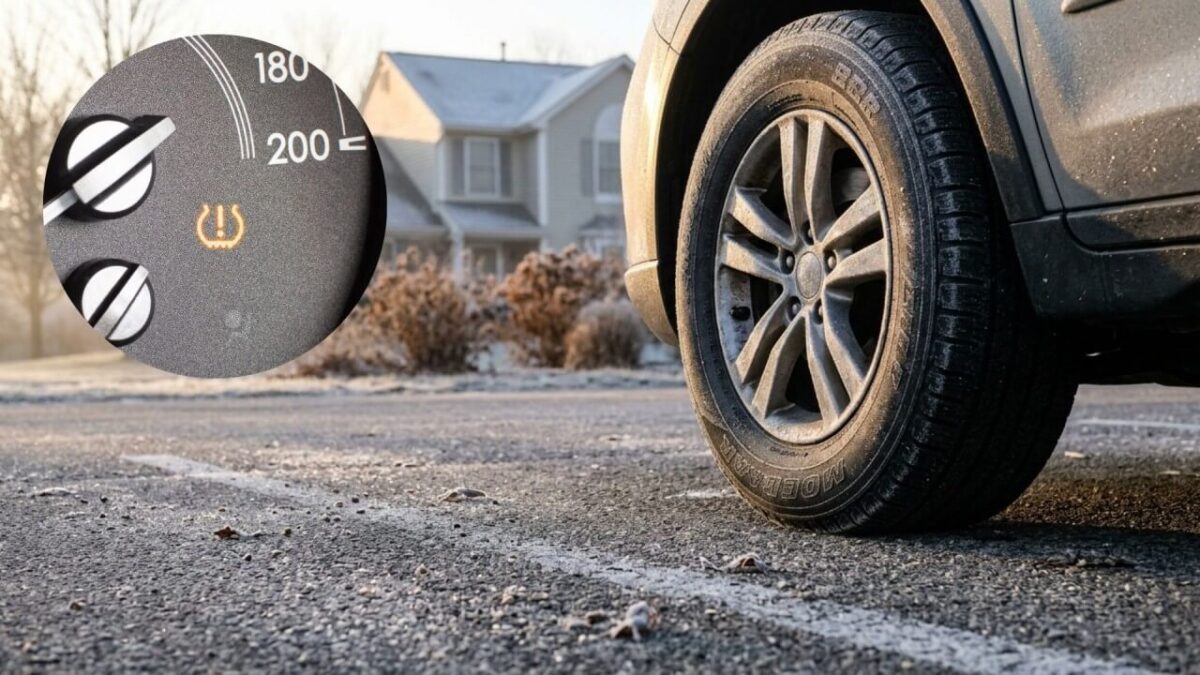
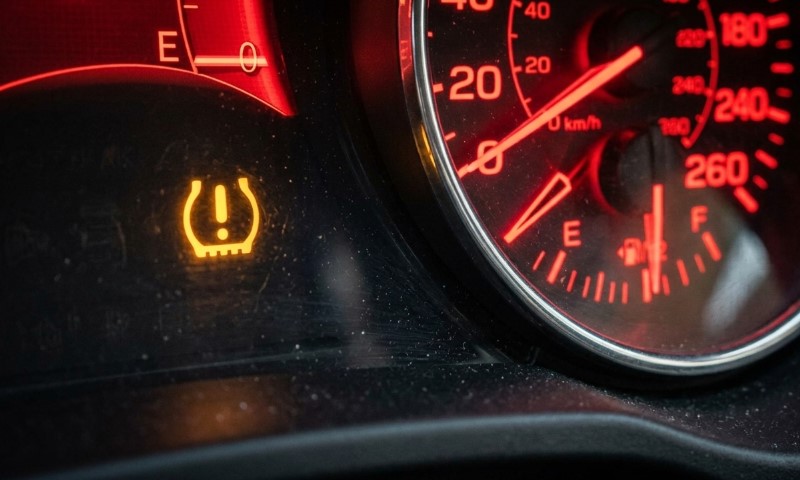
You start your car on a freezing morning, and there it is. A yellow horseshoe-shaped warning light with an exclamation point in the middle.
Yesterday, everything was fine. Today, your dashboard apparently has concerns about your tires.
A quick look outside doesn’t help much.
None of your tires appears flat, and your car hasn’t moved since yesterday evening. So did a tire develop a leak overnight, or is the weather causing trouble?
Cold temperatures can trigger the tire pressure light even when no air has escaped. As temperatures fall, air pressure inside the tires decreases, sometimes enough to activate the Tire Pressure Monitoring System (TPMS).
That doesn’t mean you should ignore the warning. A temperature-related pressure drop can still leave your tires underinflated.
Luckily, a pressure gauge and a few simple checks can usually tell you what’s happening.
Why Cold Weather Triggers the Tire Pressure Light
View this post on Instagram
Air pressure inside a tire changes with temperature. When the air cools, its molecules move more slowly, reducing the pressure they exert against the tire’s interior.
A useful rule of thumb is that tire pressure drops approximately 1 PSI for every 10°F decrease in temperature.
According to the U.S. Tire Manufacturers Association, tire pressure can change by approximately 1 to 2 PSI for every 10°F shift in temperature. A car parked outside during a 30°F overnight temperature drop could therefore register several PSI less by morning, even without a leak.
Cold weather hasn’t stolen any air. It has simply changed the pressure inside the tire, and your dashboard isn’t particularly interested in the distinction.
For example, consider a car parked outside overnight:
- Afternoon temperature – 70°F
- Morning temperature – 40°F
- Temperature difference – 30°F
- Expected tire pressure decrease – Approximately 3 PSI
A tire inflated to 32 PSI during the warmer afternoon could measure around 29 PSI the following morning, even without a puncture.
Actual changes depend on tire temperature and initial inflation pressure, so the 1 PSI rule is an approximation rather than an exact calculation.
Vehicle manufacturer documentation, including Tesla’s tire pressure instructions, confirms the approximate 1 PSI decrease per 10°F temperature drop.
Why Does a Small Pressure Drop Activate the Warning?
TPMS monitors tire inflation and alerts drivers when pressure falls below a specified threshold.
Federal TPMS requirements generally use a threshold of 25% below the manufacturer’s recommended cold inflation pressure, subject to regulatory conditions. Some vehicles provide earlier warnings.
Consider a tire with a recommended pressure of 32 PSI. If it was already sitting at 27 PSI before a cold snap, losing another 3 PSI could bring it down to approximately 24 PSI.
Now the warning makes considerably more sense.
An important detail is that tires can be significantly underinflated without looking flat. Modern tire sidewalls can disguise a pressure problem surprisingly well.
Your dashboard might seem overly dramatic, but it could be reporting a genuine condition.
Why the Light Sometimes Goes Off After Driving
Here’s where the situation gets confusing.
You start driving with the tire pressure light illuminated. Ten or fifteen minutes later, the warning disappears.
Problem solved?
Not necessarily.
As tires roll, their sidewalls continually flex. That movement generates heat, which warms the air inside the tires and increases pressure.
If pressure rises above the TPMS warning threshold, the light may turn off. Depending on the vehicle and conditions, this can happen after approximately 10 to 15 minutes of driving.
No additional air has entered the tires. Pressure has simply increased because the tires are warmer.
Your dashboard has changed its mind, but your tires haven’t necessarily fixed themselves.
Once your car sits overnight and the tires cool again, pressure can fall below the warning threshold. You might see the same light during your next morning commute.
One complication is that not every vehicle clears the light immediately when pressure increases. Some systems require pressure to reach a higher value before switching off the warning.
So a disappearing light is a useful clue, not proof that everything is fine.
How to Tell Cold Weather From an Actual Tire Leak
Cold temperatures and slow leaks can produce similar dashboard warnings. Fortunately, their pressure patterns often tell different stories.
A temperature-related drop commonly affects several tires at approximately the same time. A puncture or damaged valve is more likely to cause one tire to lose pressure faster than the others.
Here’s how to investigate without guessing.
Check the Tire Pressure While the Tires Are Cold
Start with a reliable tire pressure gauge.
For an accurate cold reading, check your tires before driving or after your vehicle has been parked for at least three hours.
Follow these steps:
| 1 | Find the recommended tire pressure on the driver’s doorjamb sticker or in the owner’s manual. |
| 2 | Remove the valve cap and press the pressure gauge firmly against the valve stem. |
| 3 | Measure and record the pressure of all four tires. |
| 4 | Compare each reading with the manufacturer’s recommended cold PSI. |
| 5 | Check for unusual pressure differences between tires with the same recommended PSI. |
Don’t use the maximum PSI printed on the tire sidewall as your inflation target. That number isn’t necessarily appropriate for your vehicle.
Also, some vehicles specify different pressures for front and rear tires, so compare the readings against the correct recommendations.
What Your Pressure Readings Actually Tell You
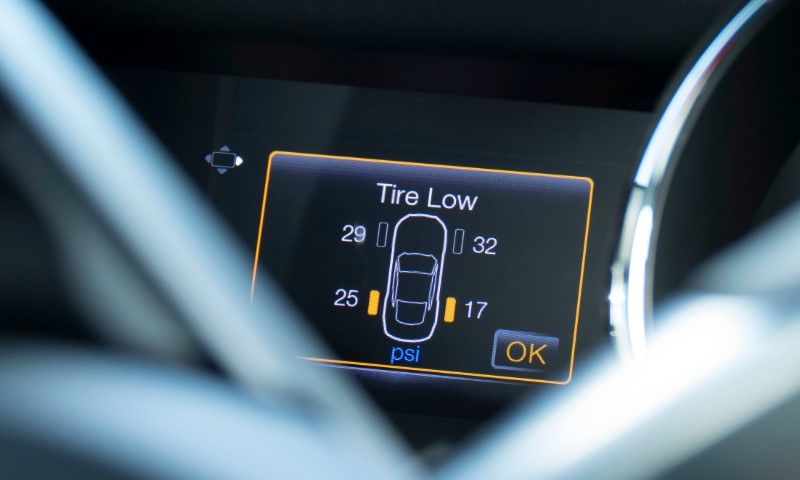
Consider an example: a sedan with a recommended cold pressure of 33 PSI on all four tires.
After a significant overnight temperature drop, the owner checks the pressure before driving.
| Tire | Measured Pressure | Difference |
| Front left | 30 PSI | 3 PSI low |
| Front right | 30 PSI | 3 PSI low |
| Rear left | 29 PSI | 4 PSI low |
| Rear right | 30 PSI | 3 PSI low |
Similar readings across all four tires suggest a temperature-related pressure change, particularly if the tires were properly inflated before the cold snap.
Now imagine the rear-left tire measures 22 PSI while the others measure 30 PSI.
That difference is harder to explain with temperature alone. A slow leak becomes a stronger possibility.
Neither pattern offers absolute proof. Several tires can lose air naturally over time, and a leaking tire can also experience temperature-related pressure changes.
Still, comparing actual readings provides much better evidence than walking around the car and deciding the tires look fine.
Watch What Happens After Adding Air
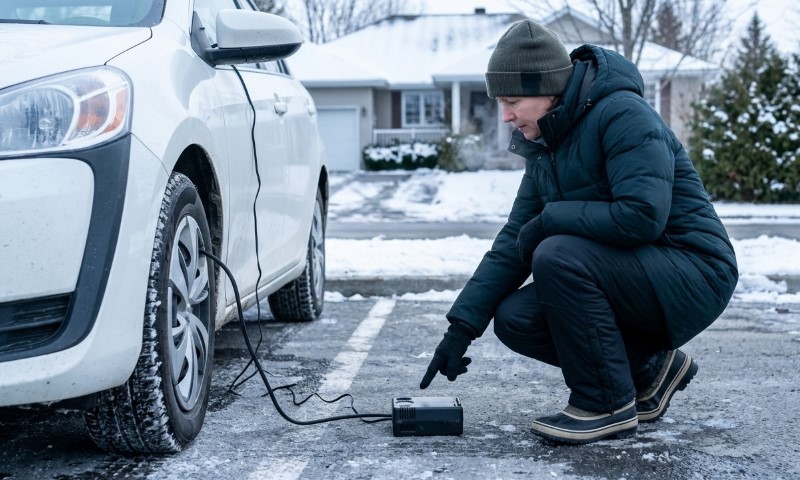
Once you’ve measured the tires, inflate them to the manufacturer’s recommended cold pressure.
Check them again over the next few mornings, preferably under similar temperature conditions.
If pressure stays reasonably stable and the warning doesn’t return, cold weather was probably responsible.
If one tire repeatedly loses several PSI while the others stay relatively stable, investigate further.
Common causes include:
- A nail or screw embedded in the tread
- A damaged or leaking valve stem
- Corrosion or damage around the wheel rim
- A poor seal between the tire bead and wheel
Uneven tire wear, repeated pressure loss, or your car pulling to one side also deserves professional inspection. Pulling can have several causes, including wheel alignment and tire damage, so it shouldn’t automatically be blamed on inflation pressure.
One easily overlooked detail is the weather during your follow-up checks. A tire measuring 32 PSI one morning and 30 PSI the next may simply have experienced another substantial temperature drop.
Compare pressure readings alongside outdoor temperatures before deciding that a tire is leaking.
If pressure falls repeatedly despite similar temperatures, a physical leak becomes more likely.
What If the Tire Pressure Light Stays On?
You’ve checked all four tires, inflated them correctly, and confirmed the readings with your gauge.
Yet the warning light is still on.
At that point, you may be dealing with the monitoring system rather than the tires themselves.
Some vehicles need approximately 10 to 20 minutes of driving before TPMS registers updated pressure readings. Others require a reset or recalibration using a dashboard button or vehicle settings menu.
Procedures differ by manufacturer and model.
Before resetting anything, consult your owner’s manual and verify that every tire has the correct pressure. Resetting a system while tires are underinflated can interfere with proper warning operation, particularly on vehicles with indirect TPMS.
A Flashing Tire Pressure Light Means Something Different
Pay attention to how the warning behaves when you start the car.
A steady light normally indicates low tire pressure.
A light that flashes for approximately 60 to 90 seconds before staying illuminated generally indicates a TPMS malfunction.
NHTSA identifies that flashing sequence as a standard malfunction warning on vehicles covered by modern TPMS requirements.
Possible causes include a failed sensor, communication problems, or an issue following wheel or tire replacement.
Direct TPMS sensors contain batteries that eventually wear out. A Mitsubishi technical service bulletin identifies an expected sensor battery life of approximately 5 to 10 years, depending on the sensor. Actual lifespan varies by design and operating conditions.
If your tire pressures are correct but the warning persists, a tire shop or qualified mechanic can diagnose the system.
A visibly flat tire, rapidly falling pressure, or unstable handling requires immediate attention. Pull over safely and don’t keep driving on a tire that may be severely underinflated.
How to Prevent the Warning on Cold Mornings
You can’t stop outdoor temperatures from falling, but you can reduce the chances of waking up to another unexpected dashboard warning.
Start by checking tire pressure at least once a month and whenever temperatures drop significantly.
Cold mornings are particularly useful for measuring pressure because the tires haven’t yet warmed up through driving.
Follow a few straightforward habits:
- Maintain the recommended cold PSI. Don’t deliberately overinflate tires because winter is approaching.
- Check after major temperature changes. A sudden 30°F drop can reduce pressure by approximately 3 PSI.
- Keep a dependable gauge in your vehicle. Dashboard warnings shouldn’t be your only way of checking inflation.
- Avoid releasing air immediately after driving. Warm tires normally register higher pressure than cold ones.
- Investigate repeated pressure loss. A tire that constantly needs additional air may have a slow leak.
If you must add air when the tires are warm, follow your vehicle manufacturer’s instructions and recheck the pressure once the tires have cooled.
Why does all this matter if the warning disappears anyway?
Proper tire inflation affects handling, tire wear, and fuel consumption. Underinflation also increases tire flexing and heat buildup, which can contribute to tire damage.
Proper inflation also makes a difference at the gas pump. According to the U.S. Department of Energy, keeping tires at their recommended pressure can improve gas mileage by approximately 0.6% on average, with improvements reaching 3% in some cases.
Nobody is getting a dramatic fuel-economy upgrade by adding a few PSI. Still, paying extra for gas because your tires need air is an especially avoidable expense.
NHTSA reports that proper inflation can extend average tire life by approximately 4,700 miles. That estimate is another reason to maintain correct pressure rather than treating the dashboard light as a seasonal inconvenience.
One final point is worth remembering. TPMS isn’t designed to replace routine inspections. Its primary job is to warn about significant pressure problems, not report every small change.
Waiting until the light appears means you may already have been driving on underinflated tires.
Sometimes It’s Just the Cold, but Check Anyway
A freezing morning can activate your tire pressure warning without a puncture, damaged valve, or missing air.
Still, the cause doesn’t change the fact that your tires may now be underinflated.
Check their pressure while they’re cold, inflate them to the manufacturer’s recommendation, and watch for unusual pressure loss over the following days.
If all four tires respond similarly to changing temperatures, the weather is a likely explanation. If one keeps losing pressure, it’s time to look for a leak.
Cold weather may be responsible for the warning, but a tire pressure gauge is what settles the argument.